
Walking the Old Salt Road
Three hundred kilometres on foot through forgotten villages.
I bought the salt on my first morning in Lüneburg, from a shop near the old market that sold almost nothing else. Salt in little linen bags, salt in jars, salt with herbs in it, salt with something purple in it that the woman behind the counter tried very hard to explain to me in English and eventually gave up on. I bought the plainest jar they had. It was about the size of a lipstick. I put it in the chest pocket of my jacket and that's where it stayed for the next six days.
I'm a cook. Was a cook, technically, for eleven years, and then I wasn't, because my wrists got bad and the restaurant closed in the same month and I took that as a sign of something. I'd been reading about old trade routes at two in the morning, the way you do when you don't have to be up at five anymore, and I found the Old Salt Route. Salt from Lüneburg, carted north to Lübeck on the Baltic, then shipped out to preserve herring for half of Northern Europe. They used to call it white gold. For a few hundred years, this little road made a lot of people very rich.
Cooks have a thing about salt. I wanted to walk the whole way with it in my pocket. That was the entire plan. My sister said it was the most me thing I had ever done, and she did not mean it nicely.
Lüneburg is a strange town to start from. Lots of the old houses lean. Not a little, either, they lean like tired people on a bus, because the town was basically built on top of the salt and the ground has been sinking for centuries. I stood in front of one for about ten minutes trying to decide if it was going to fall on me. A man walking his dog stopped and told me, in perfect English, "It has been like that for four hundred years. You are fine." Then he looked at my boots, which were very new, and said, "Your feet will not be fine," and walked off.
He was right about the feet.
The first day out of town is mostly heath and pine and these long, flat, sandy paths that look easy and are not. Somewhere in there I read the sign that explains that the salt works used to burn so much wood boiling brine that they cleared the forests for miles around, and the heather moved in after. So the purple stuff, the pretty part, the part people come out for in late summer with their cameras, is there because of all that boiling. I liked that. Something beautiful growing out of somebody's mess.
I crossed the Elbe on the second day. It's wide and brown and slow and there were swans on it acting like they owned the place. My guesthouse that night was run by a woman named Frau Behrens who looked at my blisters, said "Oh no," in exactly the tone my mother would have used, and came back with a tin of something that smelled like a horse stable and worked like a miracle. She asked why I was walking. I said for the salt. I took the jar out and showed her. She held it up to the light for a second, turned it, gave it back, and said, "Okay," like that was a perfectly normal reason. I could've hugged her.
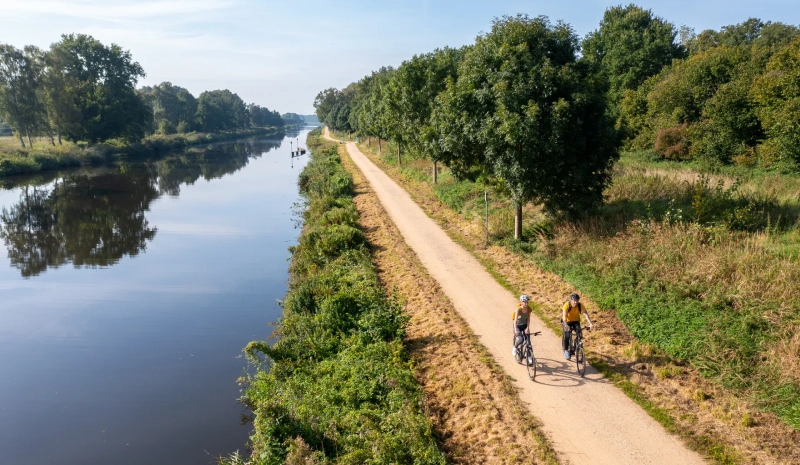
After that the path follows the water for a long time. There's a canal, the Stecknitz, that they finished in 1398, one of the first man-made waterways in Europe, built because hauling salt by cart over sand was slow and dangerous and kept getting robbed. Barges were safer. Even then, I read it took about twenty days to get a load from one end to the other. I was doing it in six with a lipstick-sized jar and a bag of gummy bears, and I still felt like I'd earned something.
There's a lot of time to think on a walk like that, which is the reason people tell you to do it and also, honestly, the worst part. For about two days my brain just ran through every service I'd ever worked. Tickets coming in. Plates going out. Somebody yelling for a side of fries that should've gone an hour ago. I'd catch myself walking faster, like I was behind. There was nobody to be behind for. A group of retired cyclists from Hamburg passed me four separate times over those two days, and by the fourth time they rang their little bells and cheered at me, and one of them shouted "Salz!" because Frau Behrens had apparently told everyone in the region about the American with the jar.
Mölln was the town where my wrists stopped hurting. I don't know why. Maybe they just got bored of complaining. I sat by a lake in the afternoon and ate a whole loaf of bread with butter and didn't time anything, didn't plate anything, didn't taste anything for anybody else. It was the best meal I'd had in a year and it cost three euros.
You see Lübeck before you get there, the spires, a whole bunch of them, green and pointed. Coming in on foot after six days, that view hit me harder than I expected. This is where all that salt was going. This is the end of the line. For hundreds of years people pulled carts and pushed barges toward these exact towers, and I was just a woman with bad knees and good boots, doing it for no reason anyone would put in a history book.
The first thing I did in Lübeck was find a fish sandwich. Pickled herring in a roll, with onions, from a little stand by the river. I'd read about that whole herring trade before I left, how the salt from Lüneburg kept the fish from rotting on the way to every corner of the Baltic, and I wanted that to be the last thing.
I sat on a bench and took the jar out of my pocket. It had gotten warm against my chest for six days. I opened it, took a pinch, and put it on the herring. It didn't need it. It was already salty, that's sort of the whole point of herring. A cook would never do it.
I did it anyway. Then I ate it slowly, watched the boats for a while, and walked back to the station, and the jar went home with me with most of the salt still in it. It's on my kitchen windowsill now. I haven't used it for anything. I don't think I'm going to.
I've been reading a lot of walking stories lately, over in the Wander section, which is where I got brave enough to write this one down. If you've got a long walk in you somewhere, I hope you write it up on VocalsMedia too. Bring good socks.
Zara Malik
Productivity nerd and recovering perfectionist.


Comments (3)
The examples really helped, thanks!
Really enjoyed this - clear and easy to follow.
Great read! The details made all the difference.